Category: science

  • Spider Disco Ball

    So I’ve known about the trick for finding spiders with a flashlight for a while now. You take a fairly powerful flashlight, hold it close to your eyes, and shine it on the ground. Spider eyes will wink back at you like little green gemstones. Since I’ve learned about it, I search for spiders on every camp out.

    During my week at Camp Comer I saw a particularly fat wolf spider near the bathroom. I looked for its eye, and saw multiple glimmers. Confused, I looked closer and discovered its whole back looked a bit like a disco ball. I’m pretty sure it was covered with baby spiders. In the picture at left you can see the spider’s eye, and two of the babies (that’s all that showed up in the flash). Trust me. There were many more babies smiling for the camera.

  • One Key to Rule Them All

    I frequently forget to unlock my door on the way out to walk the dog in the morning, and have to ring the doorbell, possibly waking people up, just to get back in. I wish the door would just know it’s me and open.

    Modern car keys enable the opening of doors just by their presence. While that’s a pretty cool piece of tech, it makes me wonder why we don’t use it elsewhere. Why doesn’t Toyota, or one of the other manufacturers, offer to sell locks for your house that open at the touch of a person holding the car key?

  • .66 < a/m < .87

    The fastest a black hole can spin is a/m = 1 (a/m is a dimensionless spin speed, obtained by setting the gravitational constant G, and the speed of light c, to 1). This may not mean anything to you, but I studied this in my thesis. Current observations of a 6.1 billion year quasar. That’s fast for a black hole.

  • Raising the Dead…


    One day while touring an Egyptology exhibit at a museum, I chanced upon an ancient inscription to raise the dead. I started to read it, and my wife got upset with me. “Haven’t you seen enough movies to know better?” This resurrection strickes me as a little less safe.

  • To the Stars!

    0.08% lightspeed is pretty fast. It will get you to the nearest star in 53 years. Of course, I’m not factoring in the time for acceleration and deceleration.

  • Supercomputing Headlights

    It’s the unexpected applications of technology that are the most amazing. Who would have thought, for example, that the simple car headlight could make use of a supercomputer? At Carnegie Melon they figured out a way to make a headlight equipped with a camera that tracks individual rain drops. Then the use a headlight with many small diodes that flicker in just such a way as to avoid shining the light directly on the droplets. The result? Much better visibility in a storm.

    Read More Here
     

  • What Adam and Eve Wrote

    I’m not generally in favor or Bible literalism, as frequently (I think) that is not how the text is meant to be read, and especially so in the case of the book of Genesis.

    People (Isaac Newton among them) have estimated the age of the earth by adding up the ages of people mentioned in scripture and come with a figure of roughly 6500 years. There are numerous reasons that this procedure of adding up ages might be invalid, for example the Hebrews were inclined to telescope generations (e.g. the Bible says that Jesus “is the son of David” when clearly he is the ancestor of David).

    Even allowing for that, it seems unlikely that we could arrive at 200,000 years, the age of the earliest modern human.

    One might postulate that the first human soul or spirit might have entered the universe around 6500 years ago, but this feels a bit too speculative an explanation to take seriously. Whether or not it is correct, humans did undergo a significant change around that time.

    It appears the earliest known writing dates to 5500 years ago. This is about a thousand years from the supposed time of Adam and Even in the garden, but it seems unlikely that we would find the first actual piece of writing. Maybe the first writing was 1000 or so years earlier. Could it be that the Biblical record actually points to the dawn of human literacy?

    It isn’t clear why gaining a soul should result in the ability to write. Maybe it doesn’t. But maybe there was some key evolutionary step in humankind, something that made the modern human the creature we recognize today, something that only happened at roughly the time pointed to by the book of Genesis.


  • A World Where it Rains Liquid Methane

    Possibly the most exciting space missions ever to have flow was the Huygens probe that landed on Saturn’s moon Titan. On Titan it is so cold that liquid methane takes the place of water, flowing in rivers and raining from the sky. The surface is startlingly earth-like, despite the fact that the “rocks” are water ice.
    The landing took place in January 14th of 2005 in the region of Xanadu.

  • Do you believe in Cold Fusion? NASA does.

    Check this out: http://technologygateway.nasa.gov/media/CC/lenr/lenr.html. LENR stands for “Low Energy Nuclear Reactions.” It is, I believe, the same reaction that Fleishman-Pons called “Cold Fusion.”

    Has nasa.gov been hacked? Have they gone crazy? Or is it true?

    I spotted this on http://nextbigfuture.com/.

  • What’s Creepier than Bugs?

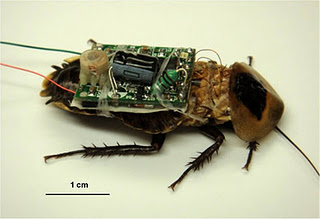
    How about cyborg bugs? Building a from-scratch robot that can do everything a bug can do is difficult. So instead, scientists are looking at a fuel cell powered by a bug’s own biochemistry. The energy can be used for sensing, recording, or control by stimulation of neurons.

    What would I like to do with this technology? Imagine creating weaponized cockroaches capable of going inside the walls, hunting down, and killing the regular cockroaches. No more pesticides.

    You can read more about it here.