Author: (author unknown)

  • MIT also working on printing buildings

    Shared by Steven

    This one is important to me. Once the printing of buildings is perfected I want to knock down my house and print one with a tower and a secret passage.
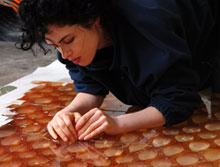
    Model maker: Neri Oxman works on “Cartesian Wax: Prototype for a Responsive Skin,” a model that is now part of the permanent collection at the Museum of Modern Art in New York. Credit: Mikey Siegel

    Neri Oxman, an architect and a professor at MIT’s Media Lab, intends to print buildings instead—essentially using concrete, polymers, and other materials in the place of ink. Oxman is developing a new way of designing buildings to take advantage of the flexibility that printing can provide. If she’s successful, her approach could lead to designs that are impossible with today’s construction methods.

    Contour Crafting and Catepillar corporation have been working on printing buildings without using forms for the concrete. Oxman’s work would take this another step, adding the ability to vary the properties of the concrete, and eventually work with multiple materials.

    D-Shape is a european effort at printing buildings

    Existing 3-D printers, also called rapid prototyping machines, build structures layer by layer. So far these machines have been used mainly to make detailed plastic models based on computer designs. But as such printers improve and become capable of using more durable materials, including metals, they’ve become a potentially interesting way to make working products.

    Oxman is working to extend the capabilities of these machines—making it possible to change the elasticity of a polymer or the porosity of concrete as it’s printed, for example—and mounting print heads on flexible robot arms that have greater freedom of movement than current printers.

    She’s also drawing inspiration from nature to develop new design strategies that take advantage of these capabilities. For example, the density of wood in a palm tree trunk varies, depending on the load it must support. The densest wood is on the outside, where bending stress is the greatest, while the center is porous and weighs less. Oxman estimates that making concrete columns this way—with low-density porous concrete in the center—could reduce the amount of concrete needed by more than 10 percent, a significant savings on the scale of a construction project.

    Oxman is developing software to realize her design strategy. She inputs data about physical stresses on a structure, as well as design constraints such as size, overall shape, and the need to let in light into certain areas of a building. Based on this information, the software applies algorithms to specify how the material properties need to change throughout a structure. Then she prints out small models based on these specifications.

    The early results of her work are so beautiful and intriguing that they’ve been featured at the Museum of Modern Art in New York and the Museum of Science in Boston. One example, which she calls Beast, is a chair whose design is based on the shape of a human body (her own) and the predicted distribution of pressure on the chair. The resulting 3-D model features a complex network of cells and branching structures that are soft where needed to relieve pressure and stiff where needed for support.

    The work is at an early stage, but the new approach to construction and design suggests many new possibilities. A load-bearing wall could be printed in elaborate patterns that correspond to the stresses it will experience from the load it supports from wind or earthquakes, for instance.

    The pattern could also account for the need to allow light into a building. Some areas would have strong, dense concrete, but in areas of low stress, the concrete could be extremely porous and light, serving only as a barrier to the elements while saving material and reducing the weight of the structure. In these non-load bearing areas, it could also be possible to print concrete that’s so porous that light can penetrate, or to mix the concrete gradually with transparent materials. Such designs could save energy by increasing the amount of daylight inside a building and reducing the need for artificial lighting. Eventually, it may be possible to print efficient insulation and ventilation at the same time. The structure can be complex, since it costs no more to print elaborate patterns than simple ones.

    Other researchers are developing technology to print walls and other large structures. Behrokh Khoshnevis, a professor of industrial and systems engineering and civil and environmental engineering at the University of Southern California, has built a system that can deposit concrete walls without the need for forms to contain the concrete. Oxman’s work would take this another step, adding the ability to vary the properties of the concrete, and eventually work with multiple materials.

    The first applications of Oxman’s approach will likely to be on a relatively small scale, in consumer products and medical devices. She’s used her principles to design and print wrist braces for carpal tunnel syndrome. They’re customized based on the pain that a particular patient experiences. The approach could also improve the performance of prosthetics.

    If you liked this article, please give it a quick review on ycombinator or StumbleUpon. Thanks

  • Powerful Ideas

    Shared by Steven

    Education is the antidote to war (just doing my bit to share the idea virus)

    Ideas are a lot like viruses. Neither a virus nor an idea is alive, technically, but both reproduce though contact with other people.  And both are hard to eradicate. For example, 20% of the American population believes Obama is a Muslim. That's actually an increase since he was inaugurated.

    Most idea viruses are the bad type. But I see no reason we couldn’t engineer good idea viruses. Such a virus would have three traits:

    1.       It must be catchy, so you never forget it.
    2.       It must be something you are inclined to share.
    3.       It must cause a positive change in the world.

    The catchy-sharing part happens all the time. You see that in the form of famous quotes.  One harmless idea virus is John Lennon's "Give peace a chance." It's catchy, and it has a positive message, but it probably doesn't cause people to act differently. It's too general.

    I’ve been tinkering with an idea virus that links education with peace. It would be a takeoff from the famous observation (and idea virus) that no two countries that both have a McDonalds ever went to war. I’m not sure that assertion is technically true. And it’s hard to act upon, short of conquering a country and forcing it to become a free market.

    Here's my engineered idea virus:  Education is the antidote to war.

    The engineering that went into that idea is that you want it to be true because it suggests an alternative to war. That’s what lets it slip past your rational defenses.

    Your rational mind can come up with lots of examples where relatively educated countries started wars. But the virus is already past your rational filter. A wanted truth is always stronger than an evidenced truth.

    The second part of the engineering is that the sentence itself is pleasing and pithy and quotable. You can imagine it on a bumper sticker. It will probably be in the tweetisphere within an hour after I post this. Here it is again: Education is the antidote to war.

    Notice that my idea virus used the word education instead of knowledge. Knowledge is a fighting word, because people always disagree on the facts. But education is universally desirable. Even the Taliban believe they need to learn some things, such as operating firearms. My idea virus is cleverly agnostic on the content of the learning.

    Is it true that education is the antidote to war? I would argue that China educated itself out of the risk of war with Russia and the United States. Education primed their economic engine, and that led to economic ties around the world. Those economic ties greatly reduce the odds of war. You might say that education is what brought McDonalds to China.

    Long term, the world will need to figure out how to improve the general education levels inside problematic countries. I can imagine a future where rich countries smuggle millions of iPads into rogue countries and provide free wireless Internet to the masses.  Then the world can sit back and let education do its thing.


  • 2010 Robot Review

    Shared by Steven

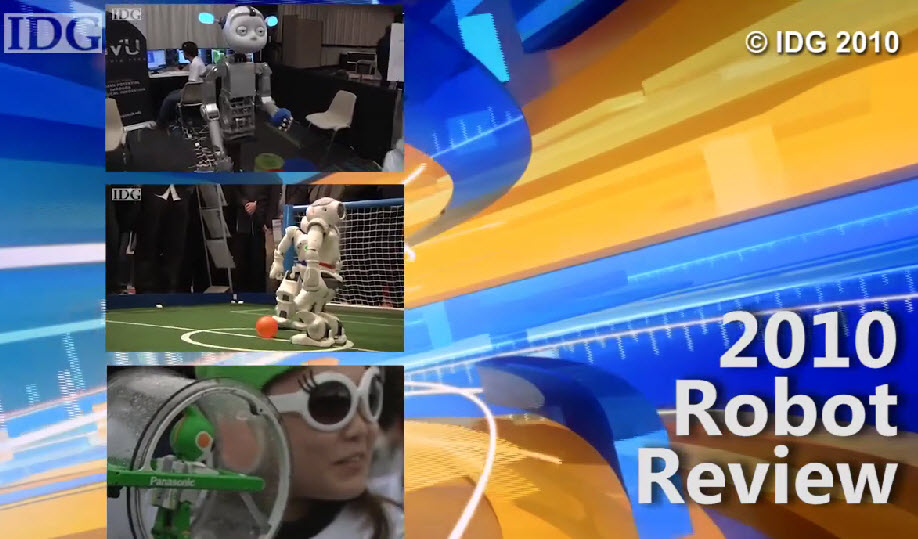
    If you think these robots still look clumsy and unwieldy, I don’t. Progress in technology tends to move exponentially, so think of how much of an advance this is in that context and what it will mean for the next decade.

    IDG News Service has produced a video review of the year’s robot news, covering home, business, sports, and space uses.
  • ilookforward.com has 11 predictions for 2030

    Shared by Steven

    I agree with most of this–except maybe #7 and #8

    ilookforward.com has 11 predictions for 2030

    1. By 2030, learning a second language will no longer be necessary.

    A tiny computer that fits in your ear, and translates what you hear into your own language? It’s not farfetched at all. In fact, all the requisite technology exists today, and all that’s missing is for someone to connect the dots.

    NBF – Google is doing a lot with real time voice translation and displays in glasses could provide additional augmented information. Need to clarify how good this will get in a prediction. A gold standard would be as good as UN translators or actually replacing or supplementing UN translators.

    2. By 2030, thousands, perhaps millions, of people will have a life expectancy of 150 years.

    Aubrey de Grey says: I think we have a 50% chance of achieving medicine capable of getting people to 200 in the decade 2030-2040. Presuming we do indeed do that, the actual achievement of 200 will probably be in the decade 2140-2150 – it will be someone who was about 85-90 at the time that the relevant therapies were developed.

    NBF – funding dependent. A lot more money has to go towards true life extension.

    3. By 2030, only 2% of the world’s population will live in extreme poverty.

    The eradication of extreme poverty will happen in our lifetime. In 1990, 42% of the world’s population lived on less than $1.25 (constant 2000 dollars, PPP). In 2005, that number had fallen to 25%. The UN estimates that by 2020, only 10% of world citizens will live in absolute poverty. My bold estimate is that by 2030, only one in 50 will.

    NBF – I don’t think it will happen because all it will take is for 160 million people in various countries to remain in a mostly screwed up place living on less than $1.25. Less than 5% living on less than $1.25 constant 2000 dollars PPP per day.

    4. By 2030, the best food will be grown in skyscrapers.

    Soil-based agriculture is so passé. Nothing short of an agricultural revolution is underway, spurred on by visionary Dr. Dickson Despommier of Columbia University. His plan is to build 30-story greenhouses in cities around the world, which will allow us to produce more food, for less money, in a healthier way, while freeing up arable land for nature.

    NBF – There will be some instances of skyscraper vertical farming, but it will not be more than 1% of all agriculture. It will be the best food in that it will mostly be for high end restaurants to have fresher food and for the luxury grocery stores.

    5. By 2030, driverless cars will be commonplace.

    I’m sure you’ve dreamed it: Getting into a car, kicking your shoes off and leaning back with a good movie and a cold beer while your self-driven car takes you safely to your destination, without your having to worry about directions or pedestrians. Well, the technology we need to make that car exists.

    NBF- need to define commonplace. It exists now on a very small scale at Masdar City and Heathrow airport. It needs to happen and it can happen but how much will it actually happen ? Legal, insurance and other societal issues need to be overcome.

    6. By 2030, 18 cities will have more than 20 million inhabitants, and New York City will be the 16th largest city in the world.

    I actually think this is a conservative estimate. Although global population is increasing at a staggering pace, the world’s cities have an ever higher growth rate. At present, 50% of the world’s population live in urban areas, but by 2030 that figure is projected at 60%. And 93% of that urban growth will occur in developing countries.

    NBF – probably more cities than that, but not particularly interesting

    7. By 2030, automated flying drones will transport humans.

    Probably a lot sooner, actually. Developing a well functioning delivery drone network will pave the way for confidence in a practical network of drones delivering people. Humans have notoriously poor navigation skills in three-dimensional environments, so unmanned aerial vehicles seem a safer option than those prone to human error.

    NBF – will an autopilot on the DARPA flying hummer count ? Then by 2016 in trials and 2020 in some pilot deployments.

    8. By 2030, space tourism will be common, and 40,000 humans will be working in orbit.

    The Space Island Group, in cooperation with British Airways, is planning to build an international, multi-purpose, commercial space station which, to begin with, will include hotels, research facilities, gourmet restaurants, and sports arenas (for new zero-gravity sports) along with dozens of other uses which can’t be imagined today. SIG is but one of a handful of companies working on similar projects.

    NBF – should have the space hotels going by 2014 and more sub-orbital tourism could transition to orbital in a bigger way. 40,000 people in total by 2030 sure. 40,000 people in space all at one time requires a lot of things to go right. Also, the things going right would also mean that the robotics and teleoperation do not boom to reduce the need for actual people to go.

    9. By 2030, most film actors will be out of work due to competition from cheap computer animated actors.

    Computer Generated Imagery (CGI) technology will enable us to create movies with animated characters so lifelike that they become indistinguishable from humans, rendering actors (in film anyway) obsolete.

    NBF – There will be more movies. More Avatar and more regular movies. More demand for movies from China and India and Korea and Brazil. So more work for actors and more CGI.

    10. By 2030, China will have 250 cities with more than one million inhabitants.

    Today, 90% of people in the UK and 80% of Americans live in cities, while in China only 46% do. The UK has five urban areas with more than one million inhabitants. The US has 37. China has 90. That’s today, and whereas the UK and the US have peaked in terms of urbanization, China is only half-way urbanized. The consultancy firm McKinsey predicts that China will have 220 cities with more than 1 million inhabitants by 2025.

    NBF- probably, but not that interesting. China will be at about 80% urbanization.
    11. By 2030, a large number of people will have robot lovers.

    This is perhaps my boldest prediction.When I ask guys if they’d get a robot girlfriend, most of them intuitively say no. They think robot and they think metal, wires, awkward motions and an empty stare. I’d say no to that too, if those were my associations with the word robot. But what if your robot partner looked, felt, sounded and even talked like a human? Robots that are physically indistinguishable from humans are only 15-20 years away.

    If you liked this article, please give it a quick review on ycombinator or StumbleUpon. Thanks

    Featured articles

    Ocean Floor Gold and Copper
       Ocean Floor Mining Company

  • Foodtubes Proposes Underground, Physical Internet

    Shared by Steven

    Dilbert Boss’ dream becomes a reality: http://dilbert.com/strips/comic/2002-03-26/

    geek4 writes “Automatically routed canisters could replace trucks with an Internet of things, says Foodtubes. A group of academics is proposing a system of underground tunnels which could deliver food and other goods in all weathers with massive energy savings. The Foodtubes group wants to put goods in metal capsules two meters long, which are shifted through underground polyethylene tubes at speeds of up to 60 miles per hour, directed by linear induction motors and routed by intelligent software to their destinations. The group, which includes an Oxford physics professor and logistics experts, wants £15 million to build a five-mile test circuit, and believes the scheme could fund itself if used by large supermarkets and local councils, and could expand because it uses an open architecture.”

    Read more of this story at Slashdot.

  • Adam Savage of Myth Busters goes through new TSA security with two – twelve inch long razor blades

    Shared by Steven

    Given things like this, why is that there has been no significant terrorist event since 9/11?

    Adam Savage, from the Myth Busters TV show, flies a lot and has dangerous items on his person for his job. He tries to make sure he leaves all that at home. But after the TSA finished shooting Adam Savage with radiation and looking at his “tiny junk”, Adam noticed he had forgotten two 12 inch long razor blades in his suit jacket. He noticed the razor blades in his pocket once he was ON THE PLANE.

    If you liked this article, please give it a quick review on ycombinator or StumbleUpon. Thanks

    Featured articles

    Ocean Floor Gold and Copper
       Ocean Floor Mining Company

  • Why complex life probably evolved only once

    Shared by Steven

    It would be unfortunate if the universe is teaming with bacteria and Earth has the only complex life.

    The universe may be teeming with simple cells like bacteria, but more complex life is probably very rare. Whenever simple cells start to become more complex, they run into problems generating enough energy, say Nick Lane of University College London and Bill Martin of the University of Dusseldorf.

  • Deterministic Parallel Java Brings Safety and Modularity to Parallel Programming

    Shared by Steven

    This looks like really exciting research. It is exactly the sort of thing the world of HPC needs.

    The first release of Deterministic Parallel Java, developed by researchers at UPCRC Illinois, guarantees deterministic semantics without run-time checks for general-purpose, object-oriented programs.

  • Google Secretly Tests Autonomous Cars In Traffic

    Shared by Steven

    If this is true, society is about to undergo a major major change.

    Hugh Pickens writes “Autonomous cars are years from mass production, but technologists who have long dreamed of them believe that they can transform society as profoundly as the Internet has. Now the NY Times reports that Google has been working in secret on vehicles that can drive themselves, using artificial-intelligence software that can sense anything near the car and mimic the decisions made by a human driver. With someone behind the wheel to take control if something went awry and a technician in the passenger seat to monitor the navigation system, seven test cars have driven 1,000 miles without human intervention and more than 140,000 miles with only occasional human control. One even drove itself down Lombard Street in San Francisco, one of the steepest and curviest streets in the nation. The only accident, engineers said, was when one Google car was rear-ended while stopped at a traffic light.” Update: 10/09 22:37 GMT by T : Reader harrymcc points out that the dream of self-driving cars is nothing new: “Both Popular Science and Popular Mechanics have regularly reported on such experiments; I rounded up some examples dating as far back as 1933.”

    Read more of this story at Slashdot.

  • Paleontologists Unearth Giant Fossilized Penguin

    Shared by Steven

    This would be a nice opening for an Indiana Jones/Bloom County mashup.

    Ponca City, We Love You writes “The BBC reports that scientists have discovered the 36-million-year-old fossil of a penguin nearly five feet tall and almost twice the weight of an Emperor Penguin, the largest living species. ‘The heavier the penguin, the deeper it dives,’ says Julia Clarke, a palaeontologist at the University of Texas. ‘If that holds true for any penguins, then the dive depths achieved by these giant forms would’ve been very different.’ The bird, named Inkayacu paracasensis, or water king, lived during the late Eocene period and had a long, straight beak, much longer than that of its modern relatives. But, most surprisingly, the giant penguin’s feathers were brown and gray, distinct from the black ‘tuxedo’” Reader SpuriousLogic notes that it’s also getting easier to keep an eye on modern penguins, since Google has extended Street View to Antarctica.

    Read more of this story at Slashdot.